A Room for the Turntable: Choosing a Stable, Convenient Spot
A turntable works best where the furniture stays steady, the controls are easy to reach and an LP can be handled without a small domestic negotiation.
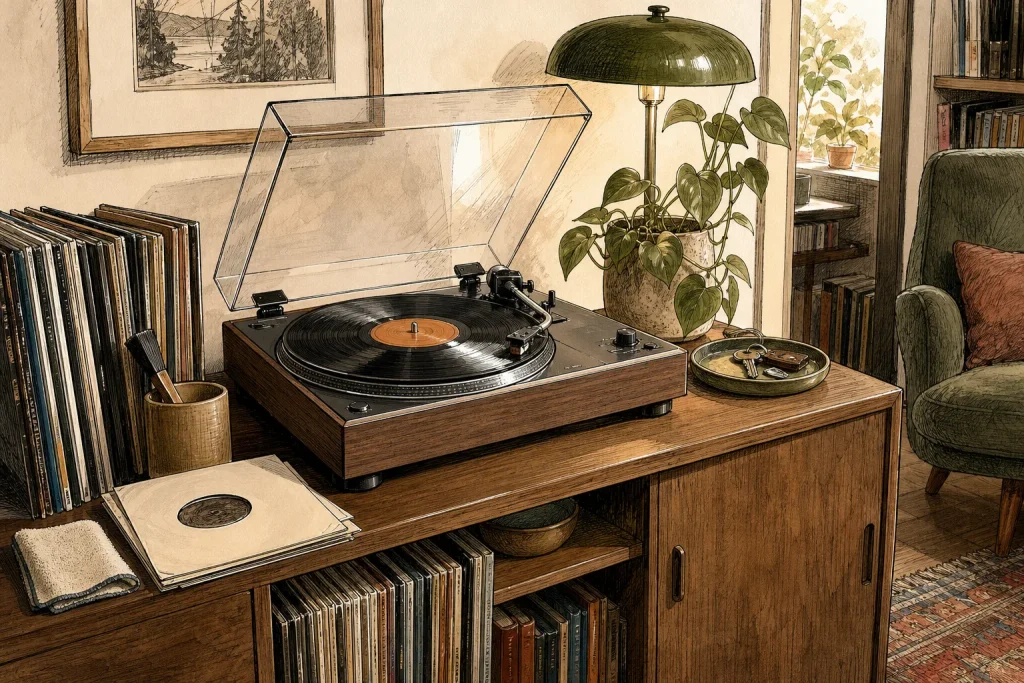
A turntable belongs on a firm, level surface with enough clear space to lift an LP from its sleeve and set it down without shifting other things first. That sounds obvious until the only available spot is a narrow shelf beside a stack of records, a lamp and the household’s preferred landing zone for keys.
Choosing a place is less about building a listening shrine than removing small irritations. A sensible position makes playback easier to start, keeps handling calm and helps the deck stay put while it works.
What makes a surface steady?
Start with the furniture, not the turntable’s feet. A sturdy cabinet, purpose-built audio rack or solid sideboard is usually a better candidate than a lightweight folding table or a shelf that flexes when pressed. Put a hand on the proposed surface and apply gentle pressure; if it wobbles, rocks or visibly bends, the deck will share the experience.
Check the floor as well. A rigid cabinet can still move on an uneven floor, particularly if one leg does not sit firmly. Adjust the furniture’s feet if they allow it, or choose another position rather than trying to correct a lively table with a pile of improvised padding.
Turntables are intended to sit level. Use the deck’s built-in level if it has one, or a small spirit level placed where the manufacturer recommends. Make adjustments to the support or the turntable’s feet according to its manual; a coaster under one corner is not a calibration method, even if it looks convincing from across the room.
Keep the deck away from a spot that gets bumped whenever someone opens a cupboard or walks past. If the furniture itself has a door or drawers, check that ordinary use does not shake the top. A record player on a cabinet that doubles as a busy storage unit may be stable in theory and troublesome in practice.
Choose the least wobbly piece of furniture you can spare, then check it with a light hand before setting up.
Where should it sit in the room?
Think about the route between the turntable, the records and the listening seat. A short, clear path makes it easier to bring over an LP, remove it from its sleeve and return it afterwards. A deck placed across the room from the collection can still work, but repeated trips around an obstacle course tend to make handling less graceful.
Leave some breathing room around the cabinet. Avoid wedging the turntable tightly against a wall or beneath a low shelf if that makes the lid awkward to open or blocks access to the back. Check the shape of the lid as it rises, not merely the closed footprint of the deck. Some lids are removable; others need the space to swing or lift clear.
Heat and direct sunlight are poor companions for records and audio equipment. Avoid placing the deck beside a radiator, in a sunny window or close to another appliance that gives off warmth. Dust also collects in neglected corners, so a position that is easy to reach and wipe is more practical than one behind a row of ornaments.
Pay attention to the speakers. Many turntable setups use loudspeakers that produce vibrations, and placing the deck on the same surface as a speaker can make unwanted movement more likely. Separate the speakers from the turntable’s support where possible, and follow the equipment makers’ placement advice. If a particular arrangement causes rumble or feedback, change the layout rather than turning the volume into a negotiation.
Leave room for the lid, the cables and a hand holding a record. A tidy photograph is not a useful measure of working space.
Can you reach the controls comfortably?
The power switch, speed selector and tonearm should be accessible without stretching across the platter. On some models, controls sit at the front; on others, the speed selector is tucked to one side. Look at the actual deck before deciding where it belongs. A turntable that requires a sleeve to be put down before you can reach the switch has been placed for appearance, not use.
Consider height as well. The controls should be easy to see and operate from your usual standing or seated position. A very low shelf can make it awkward to cue the tonearm; a high surface may encourage reaching over the platter. Keep the tonearm’s resting position and cueing lever in view, especially if the deck will be used by more than one person.
Leave the cartridge end of the tonearm clear. Avoid a position where a hanging cable, nearby ornament or record sleeve could brush against it. The stylus is delicate, so routine movement around the deck should not require threading a hand between fragile parts.
Imagine you have put an LP on the platter and notice that the power switch is hidden behind a stack of sleeves. Moving the sleeves to a nearby shelf gives the switch a clear path; the observable result is that starting and stopping the deck no longer involves reaching across the record. It is a small rearrangement, and small rearrangements are the point.
How much space does a record need?
An LP is wider than the turntable itself, and it needs a little room beyond its edge. Leave a clear surface beside the deck for the record sleeve and inner sleeve, plus somewhere to rest the jacket while you handle the disc. A clean, flat patch of furniture is preferable to balancing a sleeve on the arm of a chair.
Give yourself space to hold a record by its edges and label area while guiding it from the sleeve to the platter. The movement should not involve twisting around a lamp, reaching over a drink or passing the disc above a pile of other records. These are not dramatic hazards. They are merely avoidable ways to make a simple task fiddly.
Keep cleaning supplies nearby, but not scattered across the working area. A carbon-fibre brush can live in a small holder or drawer close at hand; a record-cleaning cloth can have a clean, dry home. Liquids should be stored away from the turntable and records, and used according to their labels. A crowded setup invites the wrong object to occupy the one clear patch you need.
Consider where sleeves go during playback. If they are placed on the floor, a chair or the edge of the cabinet, they may collect dust, get bent or become an obstacle. A nearby rack or an empty section of shelf gives jackets a temporary resting place and makes putting them away less of a second project.
Keep one clear patch for the jacket and inner sleeve. If it is already occupied, something else needs a new home.
What about cables and nearby equipment?
Route power and audio cables so they do not cross the space where you handle records. A cable caught under a cabinet or pulled tight against a connector can be damaged; a loose loop beside the platter is a needless invitation to snag a sleeve or hand. Leave enough slack for the turntable to sit naturally, but keep excess cable gathered and out of the way.
Follow the connection instructions for your particular deck. Some turntables have a built-in phono preamplifier; others require an external one or a compatible input on an amplifier. Keep the relevant equipment close enough for the supplied connections to reach without tension, and avoid stacking components in a way that blocks ventilation.
If the deck has a grounding wire, connect it as directed by the manufacturer. Do not assume every setup uses the same arrangement. When hum persists or connections are unclear, consult the manual or ask a qualified audio technician rather than trying random plugs until the system falls silent.
Keep drinks, plants and open containers off the turntable cabinet. This is not a subtle acoustic principle. Liquids and electronics have a famously limited capacity for compromise.
How can you judge the spot before settling in?
Set the turntable in place, then walk through the ordinary sequence: reach the controls, open the lid, take out a record, place it on the platter, cue the arm and return the sleeve. Notice where your hands go and what gets in their way. A position can look excellent while empty and become awkward the moment a record appears.
Check the cabinet again while operating nearby doors or drawers. Sit in the listening seat and confirm that the controls remain accessible. If you share the setup, ask another regular listener to try the same sequence; a comfortable reach for one person may be a stretch for another.
Make one change at a time. Move a lamp, clear a shelf or shift the cabinet, then repeat the sequence. That makes it easier to tell whether the new arrangement has solved the problem or merely moved it to the other side of the room.
A good turntable spot is not defined by how much equipment it can display. It is the place where the deck stays steady, the controls are reachable and a record can travel from sleeve to platter without negotiating the furniture.