Listen Again, Differently: A Repeat Play for Arrangement
A focused second listen can reveal how a song is built. Choose a listening mode, follow one part at a time, and let the arrangement come into focus without turning the record into homework.
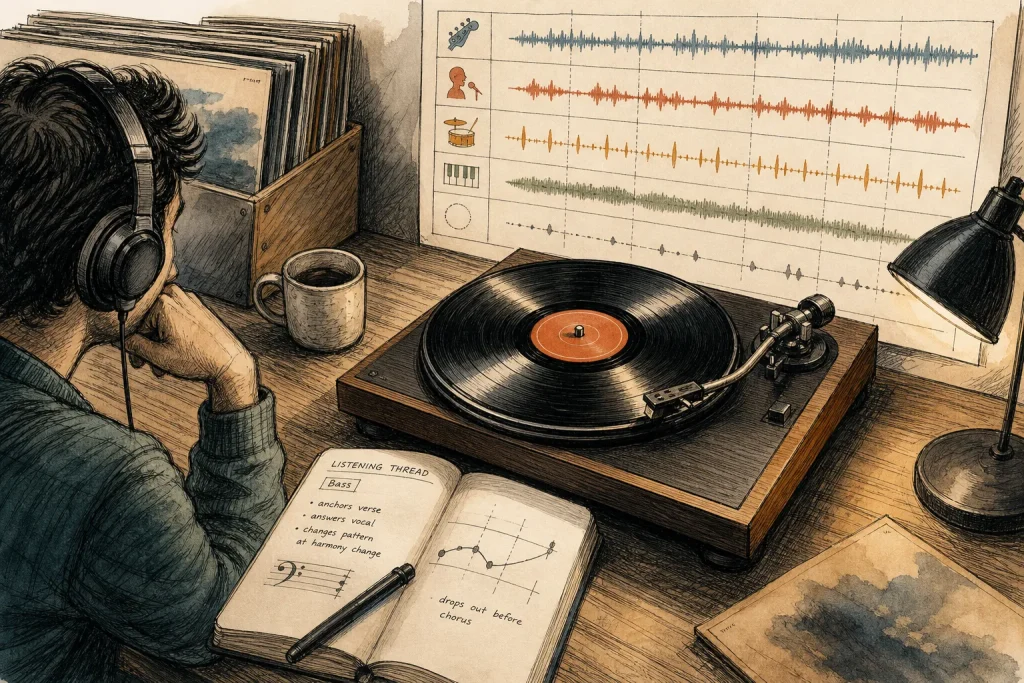
On a second play, ignore the lyric sheet and follow one sound instead: the bass, a backing voice, the drum pattern, or the space between them. A song’s arrangement often becomes clearer when you stop asking what it says and listen for what changes, what stays put, and what makes room for something else.
This is not an exam in which you must identify every instrument. Pick the approach that fits your attention today, then listen through without stopping. The record can survive being heard as a song.
What do you already notice?
If the melody keeps taking over, choose a part that sits beneath it. Bass is a useful starting point because it can anchor a verse, answer a vocal phrase, or shift its pattern when the harmony changes. Follow its shape rather than trying to name every note.
If you find yourself reading along with the words, turn the lyric sheet over or set it aside. Listen instead for the singer’s phrasing: where a line begins, where it stretches, and how the backing responds. A held note may draw out a chord; a clipped phrase may leave room for a drum fill or a breath.
If the song already feels familiar but somehow flat, track the transitions. Notice what enters after the first verse, whether the chorus gains weight, and what changes on the way back. Familiarity is useful here: you know the broad route, so small alterations have somewhere to register.
Which part should you follow?
Choose one thread for the whole play. Shifting attention every few seconds can make a busy arrangement feel like a list of chores. One thread gives the ear a job while leaving the rest of the song audible.
- Choose bass if the song feels steady or you want to hear how its foundation moves. Follow whether it repeats, climbs, drops out, or changes under a familiar section.
- Choose drums or percussion if the pulse seems to shift. Listen for changes in the pattern, accents, fills, and moments when the kit pulls back rather than simply keeping time.
- Choose backing vocals if the lead voice feels exposed. Notice whether they echo words, hold a tone, answer the singer, or appear only at a particular point.
- Choose a sustained sound, such as organ, strings, or a guitar note, if the track has a hazy or spacious feel. Follow how its texture thickens, thins, or changes beneath the main tune.
- Choose silence and gaps if the mix sounds crowded. Listen for brief openings: a beat without drums, a vocal pause, or the instant before a new layer enters.
You do not need to know the instrument’s name. “The low sound that bends at the end of the verse” is a perfectly respectable listening note.
What if the arrangement feels crowded?
Take the quietest element as your guide. This might be a shaker, a faint harmony, a short keyboard figure, or the decay of a chord after the main sound has stopped. Keep your attention on it while allowing the louder parts to remain in the background.
Say you return to a song whose chorus always seems to arrive in a rush. This time, follow a soft tambourine pattern from the second verse onward. You might notice it appear before the chorus, continue beneath the lead vocal, then disappear when the next section opens; the result is an audible sense of the chorus being prepared rather than simply announced.
If you cannot hold the quiet part in focus, choose a simpler anchor, such as the kick drum or the lead guitar’s repeated figure. The aim is attention, not an endurance event conducted in a darkened room.
What if the song barely changes?
Choose a repeated part and listen for small differences between its returns. A bass line may remain constant while the vocal grows rougher; a guitar figure may repeat while the drums add an accent; a chord may ring longer the second time. Repetition does not require sameness, though it often wears a convincing disguise.
For a deliberately spare track, focus on the relationships between sounds rather than looking for a dramatic entrance. Does the voice sit close to the guitar, or seem to float above it? Does a note overlap the next chord, or leave a clean gap? These details can carry the arrangement when there are few parts to count.
If nothing catches your ear, change the listening question rather than forcing an interpretation. Try following the ending: does the song resolve, fade, stop abruptly, or leave a sound hanging?
How should you listen on vinyl?
Put the record on as you normally would, set the volume comfortably, and choose your listening thread before lowering the stylus. Keep the sleeve nearby if you want to make a note afterwards, but avoid turning the play into a search for credits. Knowing who played what can wait; the sound is already doing its work.
For a side that runs longer than your attention, choose a section that contains a clear change, such as a verse leading into a chorus or a bridge returning to the main pattern. Listen to that passage once for the part you have chosen. If the record’s side ends before you are ready, turn it over and return another time; there is no virtue in losing the thread while reaching for a notebook.
Listen at a level that lets quieter details come through without making the louder ones uncomfortable. If surface noise distracts you, check that the record and stylus are clean and the turntable is set up correctly. Persistent playback problems are better treated as equipment or record-care questions than as a failure of concentration.
What should you do after the play?
Write down one change you heard, in plain language. “The backing voices arrive in the last chorus” is more useful than “beautiful layers”, because it records something you can listen for again. One note is enough.
You can then decide whether another play would answer a different question. If the bass clarified the song’s movement, follow the percussion next time; if the track felt static, listen for changes in vocal delivery or the way the ending is arranged. If you would rather hear the song without a task, stop there. Attentive listening works best when it leaves room for ordinary enjoyment.