Three Tracks, One Thread: Build a Playlist Around a Shared Detail
Choose one audible feature, find three tracks that use it differently, then order them so the thread carries naturally from one song to the next.
A short playlist holds together when its tracks share something you can hear, not merely a mood you can name. Choose one detail—a brushed snare, a repeated bass figure, a close-miked vocal, or a particular sort of handclap—and let three contrasting tracks show what that detail can do.
The restriction is useful. A playlist built around “late-night warmth” can drift into anything with a soft cover photograph; one built around brushed percussion asks you to listen closely and gives you a practical test for each candidate. The aim is not to make three songs sound alike. It is to make their differences feel related.
What detail can carry three tracks?
Start with a feature that is audible in a specific moment. Instrument names can help, but a detail need not be technically elaborate: the way a singer leaves a breath before a line, a guitar that keeps answering the vocal, or a steady pulse made by something other than a drum kit can all work.
Keep the detail narrow enough to recognise and broad enough to find in more than one recording. “Rhythm” is too broad to guide your choices. “A syncopated kick pattern” may be so narrow that you spend an evening auditioning songs and end with one track and a headache. “A bass line that repeats with small changes” is a serviceable middle ground.
Pick something you enjoy noticing. If you are drawn to the little scrape of a pick across strings, make that the thread; if it is the way backing voices enter late, follow that. The best detail is one that keeps your attention during an ordinary listen, not one selected because it sounds impressive in a playlist description.
How do you make the detail audible?
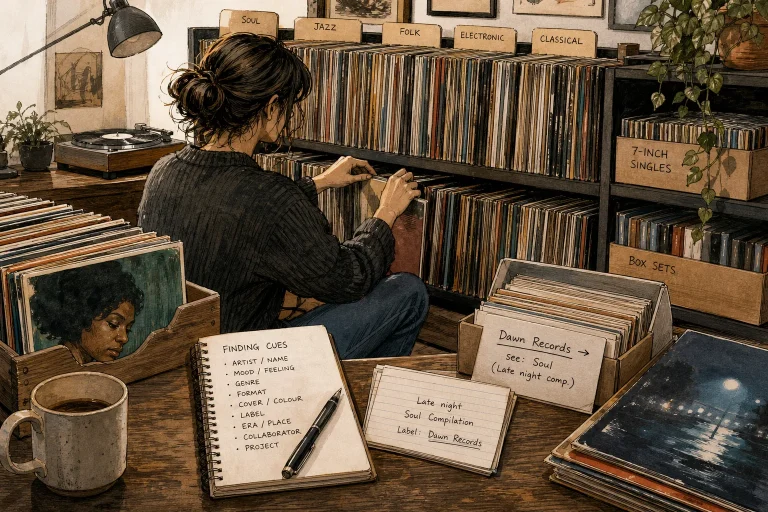
Listen to a few records you already know, or browse a small group of albums whose sound you like. Give each candidate a focused listen and note where the chosen feature appears. A paper slip tucked beside the turntable, a notebook, or a simple note on your phone is enough; no elaborate cataloguing system is required.
Write down a location in plain language: “the bass enters under the second verse” or “handclaps appear after the chorus”. If the feature appears only for a fleeting moment, ask whether that moment will still register when the track is heard in sequence. A detail can be subtle, but it should not require a lecture before it becomes audible.
Use the record itself as a useful boundary. Pulling a few candidates from one shelf or a handful of albums can prevent endless browsing, while still leaving room for unexpected connections. If you use a streaming library instead, start with saved tracks and listen rather than trusting tags; metadata is very good at describing genre and rather less good at describing a particular snare sound.
Which three tracks belong in the set?
Make a short candidate list, then keep the tracks that use the detail in distinct ways. If all three songs place the same sound in the same part of a similar arrangement, the playlist may feel like a demonstration rather than a conversation. Variation gives the shared feature room to change its meaning.
For instance, with a repeating bass figure, one track might put it up front, another might let it sit beneath a busy vocal, and a third might break the pattern near its end. The thread stays audible, but the listener has a reason to move from one use to another.
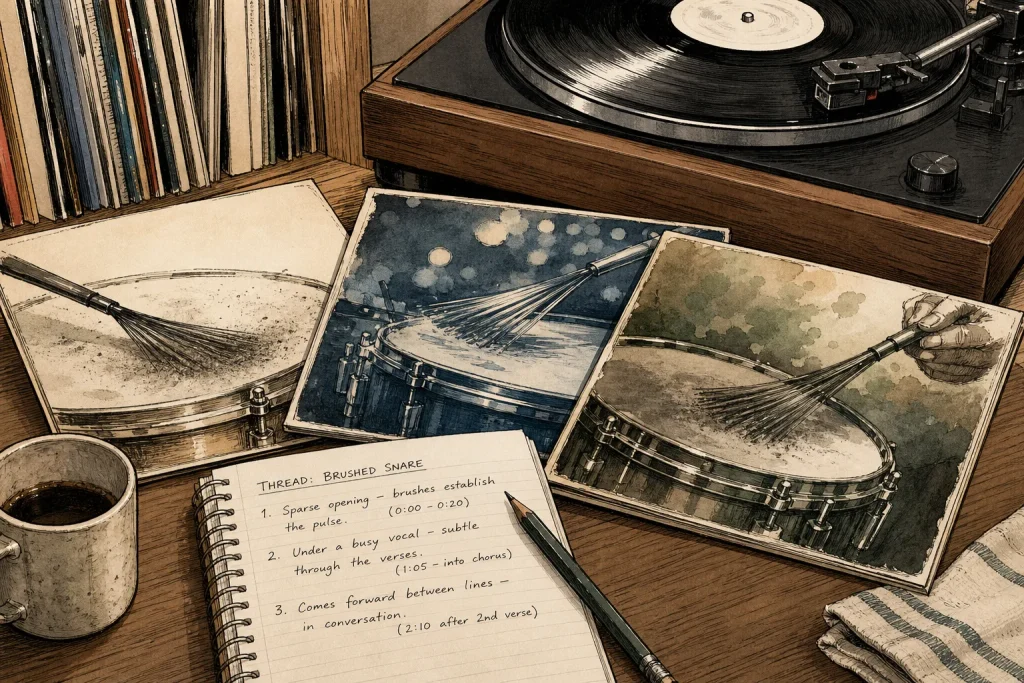
Picture someone choosing three records from a shelf around the sound of brushed snare. One track uses it in a sparse opening, another tucks it under a more animated rhythm, and a third brings it forward between vocal lines. The expected result is a small sequence in which the same soft, grainy percussion feels exposed, supporting and then conversational, rather than copied three times.
Be willing to replace a track that technically fits but weakens the set. Perhaps its key feature is buried, or perhaps it takes so long to appear that the connection has already gone cold. Keep the selection honest: the thread should be heard in the music, not supplied by your notes.
What order makes the connection clear?
Think of the three tracks as a path: establish the detail, change its role, then let it resolve or surprise. The first track should make the shared feature easy to notice without exhausting it. The second can complicate the idea; the third can offer a fresh use or a satisfying return.
Do not choose an order solely by energy, tempo, key, or the order in which the records came off the shelf. Those qualities matter, but they do not automatically explain why these particular tracks belong together. Ask what the listener hears at the end of one track and what becomes newly interesting at the start of the next.
A transition can work through contrast as well as similarity. A bright, sharply struck guitar part might give way to a muffled one, making the shared picking pattern easier to notice. A vocal that ends on a held note might meet an instrumental opening with a similar rise, even though the arrangement changes completely.
Try each possible pairing by listening to the end of the first song and the beginning of the next. You do not need to play the full tracks every time. Listen for a snag—a sudden change in density, a long fade followed by a loud entrance, or a silence that feels accidental—and decide whether it distracts from the thread or gives the sequence useful shape.
Does the transition need a technical adjustment?
First, make the musical decision. A crossfade or careful edit can soften a join, but it cannot make an unrelated sequence feel coherent. For a playlist played from a record player, the gap between sides and the act of changing records are part of the listening arrangement; choose tracks and placements that still make sense across that pause.
For a digital playlist, leave the playback settings alone at first. Listen to the transition as the service will play it, then adjust a crossfade only if an abrupt gap or overlapping tail genuinely gets in the way. If you are building a mix for a physical format, keep edits within the tools and format you know how to use, and retain an untouched copy of each source file.
Pay attention to the endings and openings, not just the central feature. A repeated bass line may unite two tracks, while a long reverb tail on one and a dry, immediate entrance on the other create a second, competing story. That may be appealing; it should be a choice rather than a surprise.
How do you check the sequence as a whole?
Play all three in order without stopping to explain the connection to yourself. Notice when the chosen detail first becomes clear, whether the middle track changes your understanding of it, and whether the final track leaves the sequence feeling complete or deliberately open.
If the thread disappears, consider changing the order before changing the songs. A feature that is hard to hear in the opening track might make more sense after a clearer introduction. If the same track still feels disconnected in every position, replace it; affection for a song is not a sequencing argument, though it is often a persuasive one in the moment.
Then listen to the transitions once more at a normal volume. Check that no track has been chosen only for a loud opening, and that the ending of the final song does not feel like an accidental cutoff. The playlist need not tell a grand story. It should give the listener a clear reason to follow one sound through three different settings.
Give the finished sequence a plain title that names the detail or hints at its character, and keep the track order visible in your notes. Next time you hear a candidate, add it to the listening pile rather than squeezing it into this set. Three tracks are enough to make a thread audible; the fourth can wait for another playlist.